
Search
adaptive mock tests with real-exam simulator

TutorWand was built around a simple idea: instructors shouldn’t have to choose between teaching well and running an efficient program.

Instead of asking you to rebuild your assessment system every few months, TutorWand offers ready to use Digital SAT mock tests that align closely with the real exam’s structure, pacing, and difficulty. The goal isn’t to replace your teaching style or force a new workflow, but to give you a stable, reliable testing layer you can trust.

What Changes for You as an Instructor

When mock tests stop demanding constant attention, your role shifts in a meaningful way.

You spend less time creating, formatting, and validating tests, and more time reviewing patterns, identifying weak skill clusters, and planning targeted lessons. Student conversations become more specific. Feedback feels clearer. Progress becomes easier to explain to both students and parents.

As your batches grow, the system continues to hold up. You’re not juggling spreadsheets or duplicating effort for every new group. The same structure supports five students or fifty, without adding complexity to your day.

It’s not a dramatic overhaul. It’s a steady improvement that compounds over time.

A Practical Advantage Instructors Care About: Cost

For many instructors, pricing is just as important as features. Tools only help if they’re sustainable.

TutorWand is designed to be one of the most affordable Digital SAT mock test platforms available for instructors, making it realistic to use at scale without inflating course fees.

  • SAT mock tests start at a very low per-student cost, significantly cheaper than most branded test-prep platforms
  • No need to invest upfront in test creation or expensive licensing
  • Easy to include in your existing course pricing without increasing student friction

This makes TutorWand especially practical for independent tutors and growing academies that want professional grade assessments without premium overhead.

Where TutorWand Fits (Without Getting in Your Way)

TutorWand was built with one clear idea: instructors shouldn’t have to choose between quality and efficiency.

Instead of asking you to build everything from scratch, TutorWand’s B2B SAT mock test offering gives you a ready foundation that respects how instructors actually work.

Here’s what that looks like in practice:

  • Adaptive Digital SAT mock tests
    Real exam-style Module 1 → Module 2 difficulty changes
  • Deep performance insights
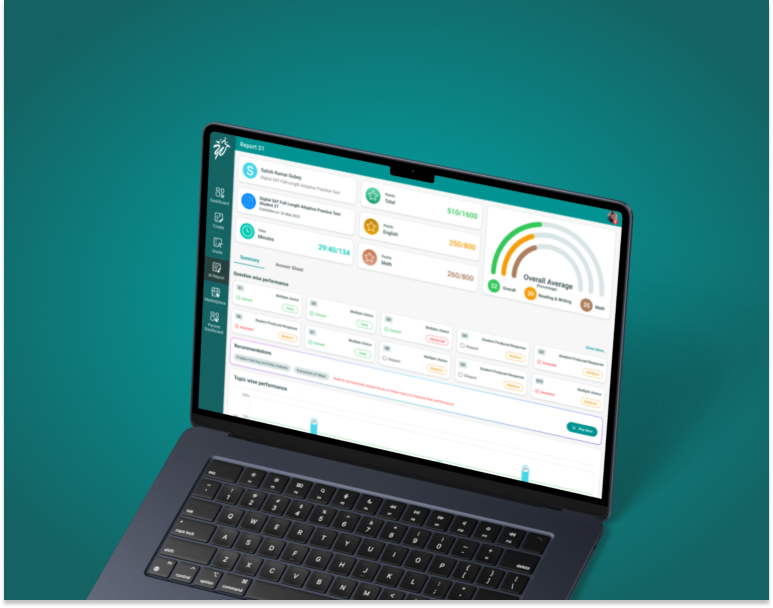
    Timing, accuracy, topic-wise breakdowns, and mistake patterns
  • Exam-aligned logic
    Question styles, section flow, and scoring patterns that feel familiar to students who’ve seen the real test.
  • Actionable AI performance insights
    Not just scores, but clarity on where students lose marks and what to address next in class.
  • Extensive Question Bank
    5000+ Practice Questions - Access a comprehensive database covering all key topics to strengthen conceptual understanding.

No forced pedagogy. No platform theatrics. Just infrastructure that works quietly in the background.

Built to Support Your Expertise, Not Replace It

TutorWand doesn’t try to teach your students for you. It handles assessment, structure, and reporting so you can focus on judgment, explanation, and strategy the parts of teaching that actually move scores.

For instructors who care about outcomes, reputation, and long-term sustainability, that balance matters.

A Quiet Invitation

If SAT mock tests currently feel like something you manage rather than something that helps you grow, it may be time for a more reliable system.

TutorWand’s B2B Digital SAT mock test offering is built for instructors who want exam-level quality, clear insights, and predictable costs without adding operational stress.

Explore it when it makes sense for you.
No noise. Just a smarter foundation for serious SAT prep.
For bulk purchases, please send an inquiry to receive exclusive pricing options customized for instructors, institutes, and large SAT preparation programs.

TutorWand your best teaching partner.

Tutorwand test quiz maker

I’ve seen teachers do this more times than I can count. It’s 11:47 p.m. A Class 10 CBSE Science test needs to be ready by morning. The chapter is “Chemical Reactions and Equations.” Half the questions are copied from last year’s paper. The other half? Made up on the fly, hoping they align with NCERT. Coffee’s cold. Eyes are tired. And tomorrow, there’s still teaching to do.

Sound familiar?

This is exactly why there’s so much buzz right now around AI-powered test creation. Across schools and coaching centers, teachers are discovering tools that can generate syllabus-aligned tests in seconds, not hours. Adaptive learning. Reduced workload. Smarter assessments. And right at the center of this shift is TutorWand, quietly changing how CBSE and State Board tests get created.

The Hot Topics Shaking Up Test Creation

Here’s what teachers, academic heads, and even parents are talking about right now. Not theory. Real classroom impact.

  • Instant chapter-wise test creation: AI tools now generate MCQs, SAQs, and LAQs for any CBSE or State Board chapter from Classes 6-12. No manual formatting. No second-guessing alignment.
  • Syllabus mapping that actually works: Tests are mapped directly to NCERT and state board syllabi, so coverage gaps don’t sneak in unnoticed.
  • Built-in analytics for insights: Instead of just marks, teachers see patterns. Which concept confused half the class? Which question was too easy?
  • Massive time savings: Many schools report up to 95% reduction in time spent creating assessments. Teachers aren’t buried in paperwork anymore. They’re actually teaching.

This shift toward personalized learning paths isn’t a luxury anymore. It’s becoming the baseline expectation.

Enter TutorWand: The Game-Changer

This is where TutorWand really stands out. It’s not just another CBSE test generator. It’s a thoughtfully designed AI platform built around how teachers actually work.

Creating a test feels almost too simple. You input the class, subject, board, and chapter. Click generate. In under 60 seconds, you get a complete test. Online version. Downloadable PDF. Auto-grading enabled. Detailed performance reports included.

I’ve spoken to teachers who now create subtopic-wise papers before every revision class. No stress. No shortcuts. One school administrator told me TutorWand felt like “magic in a teacher’s life” because assessments finally stopped being a bottleneck.

Behind the scenes, there’s a 2 lakh+ question bank, smart templates, and difficulty balancing that keeps papers fair and exam-ready. The UX is clean and intuitive. No steep learning curve. No clutter. You don’t need a demo to get started.

The real win? Teachers get their evenings back. Instead of formatting question papers, they’re planning lessons, mentoring students, or simply resting.

Tutorwand - test generator

Why It Matters

AI isn’t replacing teachers. It’s finally supporting them. For CBSE and State Board education in India, this shift matters. It democratizes access to high-quality assessments and gives teachers tools that respect their time and expertise.

If you’re still creating tests the hard way, it might be time to try something better. Try TutorWand free at tutorwand.com today. Create your first AI-powered test in under a minute and reclaim your evenings. Teaching deserves your energy. Admin work doesn’t.

TutorWand Best sat prep tool

If you’re preparing for the Digital SAT, you’ve probably heard mixed opinions:
“It’s shorter and easier,” and “It feels harder because of the adaptive format.”

Totally normal. Many students are confused about Modules, on-screen tools, and how to start preparing. The good news? Once you understand the format and follow the right study plan, the Digital SAT becomes predictable-and absolutely manageable.

This guide walks you through everything you need to get started, stay consistent, and improve your score with confidence.

Understand the Digital SAT Format

The Digital SAT is not harder-just different. Here’s what truly matters:

Adaptive Section Design

Each section has two modules:

  • Reading & Writing: Module 1 → Module 2 (Easier or Harder)
  • Math: Module 1 → Module 2 (Easier or Harder)

Your performance in Module 1 determines the difficulty level of Module 2.
Harder modules allow for higher score potential, but both paths can lead to strong results.

Shorter Test, Faster Pacing

  • Total duration: 2 hours 14 minutes
  • Fewer questions → stronger focus on accuracy
  • Built-in tools: calculator, highlighter, flag/mark options, timer

What’s different from paper SAT?

Shorter passages, more reasoning-based questions, and fully digital navigation.

Importance of SAT Practice Test

Build a Realistic Digital SAT Study Plan

A strong score doesn’t require months of stress. It requires a simple routine and consistency.

How long to prepare?

Most students do well with 6-12 weeks of structured prep, studying 45-75 minutes a day.

Weekly Study Blueprint

Mon-Wed:

  • Review 2–3 concepts (algebra, grammar, vocabulary-in-context)
  • Complete 20–30 targeted practice questions

Thursday:

  • One timed mini-section in Digital SAT format

Weekend:

  • Take a full-length digital SAT mock test
  • Review mistakes and revise weak areas

This plan helps you slowly build accuracy, speed, and stamina-without cramming.

Smart Strategies for Reading & Writing

Short passages mean every sentence counts. Here’s how to raise your Reading & Writing score efficiently:

  • Find the main idea fast: Spend the first few seconds understanding what the passage is really about.
  • Use evidence directly: Always look back at the passage before choosing an answer.
  • Master vocabulary-in-context: Think tone and meaning-not dictionary definitions.
  • Polish grammar basics: Transitions, punctuation, sentence boundaries, and agreement rules appear often.

Most importantly, practice with Digital SAT-style questions, not random worksheets.

Smart Strategies for Math

The Digital SAT Math section focuses on reasoning-less memorization, more understanding.

Key concepts to master

  • Algebra: Linear equations, inequalities, systems
  • Functions: Graph interpretation and real-world relationships
  • Data Analysis: Percentages, proportions, scatterplots, probability

Use the calculator wisely

You can use it for every question, but you shouldn’t. Overusing it slows you down and causes mistakes.

Fix common problem areas

  • Break word problems into smaller steps
  • Review function graphs regularly
  • Slow down enough to avoid small errors that cost valuable points

Practice Like the Real Test (Digital-First)

One of the biggest score gaps comes from students who prepare on paper but test on a screen.

Your prep should include:

  • Full-length digital SAT mock tests
  • On-screen navigation practice
  • Scrolling through passages
  • Using the built-in calculator
  • Working under the digital timer
  • Getting used to adaptive-style pacing

Practicing digitally conditions your brain for the real exam-reducing stress on test day.

How TutorWand Helps You Boost Your Digital SAT Score

If you’re wondering about the best way to study for the Digital SAT, the answer is clear:
Practice in the same format you’ll be tested in.

That’s exactly why thousands of students use TutorWand.

⭐ TutorWand gives you:

  • Adaptive Digital SAT mock tests
    Real exam-style Module 1 → Module 2 difficulty changes
  • Deep performance insights
    Timing, accuracy, topic-wise breakdowns, and mistake patterns
  • AI-powered personalized study plan
    Daily tasks tailored to your strengths and weaknesses
  • A clean, student-friendly interface
    Makes digital practice comfortable and stress-free

If your goal is to improve your Digital SAT score faster, TutorWand gives you the tools, structure, and insights to get there.

Conclusion: You Don’t Need to Be Perfect

Progress on the Digital SAT comes from consistency not perfection.

If you take one step today, make it this:

👉 Try your first Digital SAT-style mock test on TutorWand this week.
It’s the simplest way to understand where you stand and what to do next.

You’ve got this—and your best score is absolutely within reach.

Tutorwand Digital SAT prep

If you’ve taken a Digital SAT mock test recently, you probably know that moment.
You finish Math Module 1, the screen loads… and suddenly you’re staring at questions that feel like they were written by someone who really didn’t want you to go to college. Cue panic.

Welcome to the adaptive math module, the most misunderstood-and most anxiety-inducing-part of the new digital SAT. And honestly? Students aren’t wrong for feeling stressed. Social media is filled with versions of the same cry for help:
“One bad module and my score is doomed??”
But the real story is more interesting-and way less terrifying.

Let’s break it all down.

What the Adaptive Math Module Actually Is

The Digital SAT uses something called multistage adaptive testing. Sounds complicated, but the idea is simple:

  • Everyone takes Math Module 1.
  • Based on how you perform, the SAT routes you into either an easier or a harder Module 2.
  • Your final score depends on total accuracy and the difficulty of the module you reached.

That’s it. No secret traps. No hidden algorithm trying to wipe out your dreams.

But here’s why students feel like it’s unfair:
Module 1 feels like a gatekeeper. One shaky start, one burst of nerves, and students believe they’ve “lost” their shot at a 700+ score.

Digital SAT Math Tips and Guide

Why Students Are Worried (and Talking About It Everywhere)

If you scroll through Reddit, Discord study servers, or TikTok studytok, you’ll see:

  • Students afraid that one “bad round” will lock their score
  • Complaints that they didn’t know whether Module 2 was “easy or hard”
  • Anxiety that the adaptive system is “rigged”
  • Confusion about how many questions they need to get right in Module 1

This uncertainty fuels the panic.

But from the College Board’s perspective, the adaptive system is meant to be efficient. Instead of giving every student 60+ questions, they give you fewer-but more targeted-questions to understand your skill level.

The catch? Students weren’t trained for this shift.

What’s Really Going On Behind the Scenes

Let’s clear up the biggest misconceptions.

Myth #1: “If you get one question wrong, you’re doomed.”

Nope. You don’t need perfection to reach the harder module.
Most data suggests that about 70% accuracy (roughly 15-16 questions right in Module 1) is enough.

Myth #2: “The harder module is impossible.”

Harder ≠ impossible.
Harder simply means the questions carry more scoring weight. They’re designed to separate good from great-not crush you.

Myth #3: “Easier Module 2 means you have no chance of a good score.”

Not exactly. You can still land a solid score. But the ceiling is lower because the test is assessing a different band of difficulty.

Fact: Adaptive isn’t punishment-it’s precision.

It’s not trying to trick you.
It’s trying to measure your ability without making the test longer.

Once you understand this shift, the anxiety drops-and strategy takes over.

How to Beat the Adaptive System

Yes, you can “beat” it. Not by gaming it, but by approaching it the right way.

1. Protect Your Mindset in Module 1

Module 1 is your gateway.
Show your best work here-not rushed work.

A calm Module 1 > a fast Module 1.
Slow down just enough to avoid silly mistakes.

2. Use Smart Pacing, Not Speed

Adaptive exams reward accuracy far more than speed.
If a question looks like a time-sink, flag it and keep moving. Time is your real enemy.

3. Do a 30-second Mental Reset Before Module 2

Don’t carry frustration (or overconfidence) into the second module.
The reset is simple: deep breath, shoulders down, tell yourself:
“New module, new chances.”

4. Stop Relying on Old Paper Prep

Traditional prep does not prepare you for:

  • Adaptive difficulty jumps,
  • Digital pacing,
  • On-screen calculator habits,
  • Or the psychological pressure between modules.

The digital SAT requires digital training.

This is where the right practice tool makes all the difference.

Where TutorWand Comes In (The Part That Actually Helps)

If you want to beat an adaptive system, you need to train adaptively, not harder.

TutorWand was built for the digital SAT era. Its math mocks don’t just copy the SAT—they mirror the adaptive logic, the scoring behavior, and the module routing decisions.

Here’s what makes the difference:

  • Adaptive modules that feel like the real thing
  • Precise performance analytics (accuracy, pacing, difficulty bands)
  • Realistic scoring estimates based on actual SAT style scoring
  • Stress-free simulations so test day feels familiar, not scary

Take Maya, for example-your classic “good at math but terrified of surprises” student.
Her first mock showed she rushed Module 1 and missed five easy questions. TutorWand’s analytics pointed this out clearly. After two weeks of adaptive drills and pacing fixes, she hit the harder module consistently-her projected score jumped from 590 to 670.

Not because she became a math genius.
Because she trained for the system.

With the right prep, adaptive testing becomes an advantage, not a threat.

Final Thoughts: Train Adaptive, Not Just Harder

The adaptive math module isn’t something to fear-it’s something to understand.
Once you do, the test stops feeling like a trap and starts feeling like a game you can actually learn to play.

If you’re serious about cracking the Digital SAT, start practicing the way the test behaves.

👉 Try TutorWand’s adaptive SAT math practice today-and change the way you prepare.

Boost Your SAT Writing Score: Standard English Conventions

If you’re preparing for the SAT, especially the Writing and Language section, you’ve probably heard people talk about “Standard English Conventions.” For many students, this part of the test feels tricky-not because the questions are impossible, but because the rules can feel scattered or confusing. The good news? With the right approach, mastering these conventions becomes one of the most reliable ways to boost your score.

Whether you're searching for the best SAT grammar rules, looking for SAT Writing and Language tips, or simply wondering how to improve SAT English, this guide will give you a clear path. Let’s break everything down in a simple, friendly way.

What Are Standard English Conventions?

On the SAT, Standard English Conventions refer to the grammar, punctuation, and sentence-structure rules that form the foundation of clear writing. These are the everyday rules that help sentences make sense-things like using correct verb tense, punctuation marks, pronouns, and clause structures.

When you see questions labeled under “standard English conventions SAT,” they’re usually targeting:

  • Sentence boundaries
  • Agreement between subjects and verbs
  • Logical and precise pronoun usage
  • Correct punctuation
  • Clear sentence structure

In short: the SAT wants to know whether you can identify and fix the kinds of writing issues that interrupt clarity.

Common Grammar Areas Tested in SAT Writing

To score well, it helps to know exactly what to expect. Here are the grammar categories that show up again and again-along with why they matter.

Punctuation

The SAT loves punctuation. Expect questions about commas, semicolons, colons, and dashes. Here’s a quick example:

Incorrect: The students studied all night however, they were still tired.
Correct: The students studied all night; however, they were still tired.

The key? Punctuation must match the structure of the sentence. Practice recognizing when you have a complete thought versus just a fragment.

Verb Tense Consistency

One of the most common SAT grammar mistakes to avoid is switching tenses for no reason.

Incorrect: She walks into the room and noticed the lights were off.
Correct: She walks into the room and notices the lights are off.

The SAT requires the verb tense to match the timeline of the sentence.

Subject-Verb Agreement

A classic SAT favorite. Singular subjects must have singular verbs; plural subjects must have plural verbs-even if distracting words get in the way.

Example:
The bouquet of roses is on the table.
(Not “are,” because bouquet is singular.)

Pronoun Clarity and Agreement

Pronouns must clearly refer to one specific noun, and they must match in number and case.

Unclear:
When the students met the teachers, they were excited. (Who was excited?)

Clarity is everything-especially in SAT grammar rules related to pronouns.

Sentence Structure

Expect questions on misplaced modifiers, parallel structure, and combining sentences smoothly.

Incorrect modifier:
Running quickly, the finish line appeared closer.
(The finish line wasn’t running!)

Practical Tips to Master These Grammar Skills

Learning grammar doesn’t have to be overwhelming. Here are simple ways to level up:

Tip 1: Review One Skill at a Time

Instead of memorizing dozens of rules, focus on categories. For example, spend one day on punctuation, one on verbs, one on pronouns.

Tip 2: Learn from Mistakes

Every error teaches you something. Mark the questions you miss and revisit them weekly.

Tip 3: Read Actively

Reading well-written articles helps you internalize grammar patterns naturally.

Tip 4: Practice with Realistic Tools

Prioritize SAT full-length practice and adaptive SAT mock test options that reflect the real exam difficulty curve.

Tip 5: Mix Vocabulary + Grammar

Even though vocabulary is less emphasized now, using a little free SAT vocabulary practice strengthens your understanding of correct sentence structure.

How TutorWand Helps Students Learn Faster

If you want an effective, structured, and realistic way to practice, TutorWand.com is one of the best online platforms for SAT preparation.

TutorWand helps students master Standard English Conventions by providing extended solutions for every question, along with deep, step-by-step explanations of the underlying grammar rules. This ensures not only that you know the correct answer, but also why it is correct and how the rule works in real SAT contexts.

With TutorWand, students gain a clearer understanding of grammar concepts such as sentence structure, punctuation, usage, and agreement-helping them improve accuracy, confidence, and overall test performance much faster.

Adaptive Full-Length SAT Practice Tests

TutorWand’s SAT full-length adaptive practice tests are built to feel just like the real exam.

  • Adaptive difficulty: Module 1 performance changes the difficulty level of Module 2, exactly like the digital SAT.
  • Real pacing experience: You learn how to manage time when the test dynamically adjusts to your performance.
  • Instant score prediction: The system analyzes your answers and provides score estimates aligned with official SAT patterns.
  • Detailed English subscore breakdown: You can see how you performed in grammar, punctuation, structure, and expression-no guessing required.

Focused Unit Tests for Grammar Mastery

These shorter, topic-based quizzes help you sharpen specific grammar skills.

  • Single-topic mastery: Target punctuation, sentence structure, tense consistency, pronouns, and agreement one at a time.
  • Progressive difficulty: Questions gradually increase in complexity so you learn in layers, not in overload.
  • Error pattern tracking: If you repeatedly miss pronoun clarity or comma rules, TutorWand highlights it immediately.
  • Skill sharpening: Perfect for quick revision sessions before school or during study breaks.

Smart Analytics That Show Your Weak Spots

TutorWand doesn’t just tell you that you got a question wrong-it explains why.

  • Weak area identification: It pinpoints grammar categories where you lose the most points.
  • Time analysis: See whether mistakes come from rushing, overthinking, or misreading.
  • Explanation-first approach: Every question includes a clear, human-style explanation of the rule behind the answer.
  • AI-powered study plan: The platform recommends specific lessons, exercises, and unit tests based on your performance patterns.

5,000+ Updated SAT Grammar & Writing Questions

With TutorWand, you get more than just volume-you get relevance.

  • Latest-format questions: Short passages, sentence correction, structural improvement, and context-based grammar problems.
  • High-yield topics: Questions focus on the exact grammar rules that appear most often on recent SAT exams.
  • Realistic distractors: Answer choices mimic the subtle traps found on official tests-so you’re never surprised on test day.
  • Built for improvement: Each question reinforces core concepts, helping you internalize patterns that lead to higher scores.

Mastering grammar isn’t just about raising your SAT score-it’s about becoming a clearer, more confident communicator. A strong command of Standard English Conventions is not just for the SAT-it’s a life skill that shapes clear, confident communication.

Start mastering your SAT grammar today with TutorWand-your companion to real SAT success!

Digital SAT Simulator 2026

Preparing for the SAT has changed dramatically-especially now that the exam is fully digital and adaptive. Gone are the days of paper booklets, bubble sheets, and long test sessions. Today’s students face an exam delivered entirely on a device, with dynamic question difficulty and built-in digital tools. Because of this shift, more students, educators, and parents are looking for Digital SAT practice tests, adaptive SAT mock exams, and AI-powered SAT simulator platforms that truly reflect the real experience.

One of the most important trends in SAT prep for 2026 is practicing in an interface that feels familiar. And that’s where a Bluebook-style Digital SAT Simulator becomes a game-changer. “Bluebook-style” simply means an intuitive, user-friendly digital interface that closely resembles the official Digital SAT environment-without referencing any proprietary content or tools.

When students can practice in a realistic environment, they build the kind of confidence and pacing control that traditional paper tests simply don’t support. Let’s break down why this matters and how TutorWand has emerged as the top choice for modern SAT prep.

Why Real Exam Simulation Matters More Than Ever

Familiarity With the Digital SAT Tools

The official exam includes on-screen tools like:

  • Highlighters
  • Answer eliminators
  • Timer and question navigator
  • Easy navigation between questions

A Bluebook-style interface mirrors all these elements so students don’t waste valuable test time figuring out how the platform works. This boosts confidence and reduces anxiety-especially for students new to digital-only exams.

Practicing Under Adaptive Conditions

The digital SAT isn’t just online-it’s adaptive. That means:

  • Module 1 performance directly influences the difficulty of Module 2
  • Accuracy in the first stage matters more than ever
  • Students must be prepared for both possible difficulty routes

A standard mock test can’t replicate this. Only an adaptive SAT mock exam in a controlled digital interface can help students understand how the test “responds” to their performance.

Improved Pacing and Accuracy

Digital environments change how students manage time. Shorter text passages, faster response cycles, and on-screen scrolling all affect pacing.

Practicing in a real exam simulation helps students:

  • Build digital reading stamina
  • Adapt to screen-based math problem solving
  • Improve accuracy by reducing navigation mistakes

These subtle advantages stack up to make a big difference on test day.

TutorWand: The Ultimate Bluebook-Style Digital SAT Simulator

While many SAT prep apps offer digital practice, TutorWand’s Digital SAT Simulator stands out because it doesn’t just give students questions-it replicates the entire testing experience in a Bluebook-style, user-friendly interface.

Here are the features that make TutorWand the most advanced Digital SAT preparation tool available today:

AI-Driven Adaptive Testing (True SAT Simulation)

TutorWand uses cutting-edge AI to mirror the official SAT structure:

  • Module-by-module progression
  • Adaptive difficulty based on performance
  • Realistic timing and scoring patterns

This is not a generic test engine-it's an AI-powered SAT simulator built specifically for the Digital SAT format of 2026 and beyond.

Bluebook-Style On-Screen Tools

TutorWand includes digital tools that closely resemble those students will see on the real exam:

  • Built-in scientific and graphing calculator
  • Text highlighter
  • Answer eliminator
  • Review panel
  • Digital timer
  • Seamless navigation between questions

This level of interface authenticity prepares students for the exact cognitive flow of test day.

Instant Performance Analytics & Personalized Study Plans

After each test, TutorWand breaks down performance with:

  • Skill-by-skill accuracy
  • Module difficulty path analysis
  • Time spent per question
  • Weak-topic detection
  • Personalized SAT study plans generated by AI

This transforms each test into a data-driven learning experience-not just a score check.

4,000+ Updated SAT Questions

TutorWand’s question bank is one of the most extensive and up-to-date in the industry:

  • All questions match the latest Digital SAT pattern
  • Includes new-style short reading passages
  • Data analysis, algebra, advanced math, and problem-solving
  • Regular expert updates keep content fresh

Students get exposure to every tested skill across difficulty levels.

Why Students, Educators & Parents Trust TutorWand

TutorWand is more than a test simulator-it’s a complete Digital SAT preparation ecosystem designed for 2026’s adaptive exam. Its realistic testing interface, AI-powered analytics, and flexible access make it the most reliable option for building confidence and improving scores.

Whether you’re a student aiming for top colleges, a parent seeking reliable resources, or an educator guiding a classroom, TutorWand ensures every learner gets the most authentic practice possible.

Start Your Digital SAT Journey With TutorWand

Success on the Digital SAT begins with practicing the way you will perform on test day. TutorWand’s Bluebook-style Digital SAT Simulator offers the closest experience to the real exam-adaptive, intuitive, and designed for mastery.

👉 Try TutorWand’s free or premium adaptive SAT practice tests today and give yourself the advantage of a realistic, engaging, and data-driven SAT preparation journey.

With TutorWand, you’re not just preparing-you’re preparing smart.

If you’re gearing up for the SAT this year, you’ve likely seen “digital SAT 2026,” “SAT prep tools,” and “SAT practice tests” trending everywhere. But what does this really mean for your preparation? As we move deeper into 2026, new test patterns and smarter learning methods are reshaping how students study. Let’s explore the most talked-about trends in SAT prep 2026 - and how to prepare effectively.

SAT Dec 2025

The New Digital Format: What’s Changed

The digital SAT 2026 has transformed how students take the exam. It’s shorter, adaptive, and designed for modern test-takers.

  • Shorter Test Time: Around 2 hours 14 minutes instead of 3.
  • Adaptive Modules: Each section has two modules - the second adjusts in difficulty based on your performance in the first.
  • Math Updates: Calculators are now allowed for all math questions. Expect more data-driven and real-world problem-solving tasks.
  • Reading & Writing Shift: Long passages are gone; questions are now based on concise texts that test logic and language precision.

These updates mean your study plan for SAT needs to focus on accuracy, adaptability, and digital familiarity, not just content knowledge.

What Students Are Discussing Online

Across Reddit, Discord, and student forums, test-takers are buzzing about three major topics:

  • Adaptive Learning for SAT: Students are turning to AI-driven tools that adjust question difficulty based on performance, mirroring the real test.
  • Interface Practice: Many say the on-screen calculator and question-flagging tools take practice - so familiarity with digital navigation is key.
  • Shorter Study Bursts: Instead of marathon study sessions, students are preferring 30-minute adaptive drills to build focused stamina for digital modules.

The message is clear: successful prep now depends on practicing smarter, not just longer.

Expert-Backed Preparation Tips for 2026

To thrive on the new SAT format, here’s what educators and high-scoring students recommend:

  • Simulate Real Conditions: Take adaptive mock tests in the same interface and timing as the official digital SAT.
  • Focus on Accuracy Early: The first module determines your difficulty path - so aim for precision, not speed, in your initial responses.
  • Track Data, Not Just Scores: Identify weak skills using detailed analytics and adjust your study plan for SAT accordingly.
  • Review Intelligently: Classify each mistake - concept error, pacing issue, or misread - and correct the root cause.
  • Stay Consistent: Practice shorter modules daily instead of occasional full tests to maintain momentum.

These habits mirror what the SAT 2025 rewards: consistent accuracy under adaptive conditions.

TutorWand - Your Smartest Partner for SAT Prep 2026

Among the latest SAT prep tools, TutorWand stands out for blending AI and adaptive testing in one platform. Here’s why educators and students are recommending it:

  • Adaptive Question Suggestions: TutorWand analyzes your responses and instantly adjusts difficulty to fit your learning curve.
  • AI-Driven Learning Plans: Its smart planner recommends exactly what to practice next, saving you hours of guesswork.
  • Real Digital SAT Simulator: Practice tests mimic the Bluebook interface - timer, calculator, question navigation - for authentic exam experience.
  • Detailed Insights: Get instant analytics - accuracy by topic, time spent per question, and personalized improvement charts.

With over 4,000 questions and realistic mock tests, TutorWand is more than a study app; it’s a complete adaptive learning ecosystem built for the digital SAT era.

👉 Explore TutorWand: www.tutorwand.com

Final Thoughts – Start Early, Study Smart

The new SAT 2026 rewards agility, adaptability, and precision. As you plan your prep journey, lean into digital SAT strategies - simulate real tests, analyze your data, and let AI tools guide your next steps.

Platforms like TutorWand help you focus where it matters most, turning prep time into measurable progress.
So why wait? Start your SAT prep today with TutorWand and take the first confident step toward your dream score.

The Digital SAT is clearly in its next chapter - and if you’re preparing for 2026 (or beyond) you’ll want to align your strategy to how the test has changed and how students are best adapting. Below is a full-laid-out blog-style guide: first summarizing the new features, then the most effective strategies for the adaptive digital format, and finally, why full-length digital mock exams matter more than ever. I’ll also highlight why the platform TutorWand stands out for this new era - plus mention a few other good resources - and finish with a set of actionable tips you can start using right away.

Digital SAT Prep guide

Top Strategies for the Adaptive Digital Format

Given these changes, your preparation approach needs to adapt. Here are the most effective strategies:

  • Get comfortable with the device and interface first.
    Before you dive deep into content, make sure you're fluent in navigating the digital interface: moving between questions, using the on-screen calculator, flagging/marking questions, timing yourself on modules, and so on. The test won’t wait for you to learn these on test-day.
  • Practise in module format before full tests.
    Since each section is modular and adaptive, it makes sense to practise by modules: first half of Reading/Writing (module 1), then reflect on performance, then second half (module 2) in simulation. Then repeat for Math. This builds the pacing and strategic awareness of “how am I doing and what module might I get next?” rather than just “finish 100 questions”.
  • Focus on performance early in module 1.
    Because your performance in module 1 affects the difficulty (and therefore your potential ceiling) of module 2, you want to perform well early. That means accuracy + time management are critical early rather than saving energy for the end. Mistakes early can mean getting placed into a less challenging second module - and that might cap your maximum score.
  • Review mistakes with digital-specific mind-set.
    In the digital version, errors often come from interface/format issues (e.g., mis-clicking, failing to switch calculator mode, misreading a passage on screen) or from under-estimating pacing in modules. So when you review, tag mistakes as content errors, format/interface errors, and timing errors - then correct all three.
  • Use full-length digital mock exams under realistic conditions.
    Yes - you’ll still want full tests - but they must mimic the digital version exactly: same device, same set-up, with breaks, modules, and the interface. This builds stamina, familiarity with fatigue, and gives you practice in “whole test day” environment. More on why this matters in the next section.
  • Mixed-resource approach works best.
    Don’t rely on one resource. Combine official materials (because they reflect the actual test), good commercial platforms (for breadth and simulation), and your own tracking system for errors + patterns.

Why Full-Length Digital Mock Exams Are Critical

Here’s why you can’t skip full-length digital simulations:

  • True pacing and fatigue realism. Two hours plus a break replicates the real test, with all the mental stamina required. Shorter practice sets are good for skill-work, but full tests build test-day endurance.
  • Interface-familiarity under pressure. Full tests simulate the actual interface, help you deal with any quirks (device lag, navigation, calculator bugs) and reduce surprises.
  • Adaptive module awareness. Taking full tests lets you experience the full pattern: module one → module two (harder or easier) for both sections. Without that exact format, you won’t know how you’ll be placed, or how you’ll cope with tougher second modules if you’ve earned them.
  • Analytics and error-tracking across modules. Full-length mocks give you comprehensive data: how you did in module 1 vs module 2, where you lost time, how your accuracy shifted. That data is gold for targeted review.
  • Confidence building. Each full-mock you complete builds your “I can finish this test under real-conditions” confidence. That matters a lot on test-day when the format is new and perhaps a little intimidating.

Why TutorWand Is the Ideal Platform for the 2026 Digital SAT

When it comes to full-length digital mock exams tailored for this new era, this is where TutorWand shines:

  • Realistic digital simulation: TutorWand’s full-length mocks are built to replicate the exact format of the Digital SAT - modules, timing, on-screen calculator, device layout - so you’re practising what you’ll face.
  • Adaptive-experience training: TutorWand includes simulated adaptive modules, giving you a real taste of the first-half performance → second-half harder/easier possibility. That trains you psychologically and strategically.
  • AI-powered analytics: After each full test TutorWand gives rich analytics: your time per question, module-by-module performance, content-error breakdown, format/interface-error tagging. Because you’re preparing for a new format, this level of insight helps you target not only “I got content wrong” but “I lost time because of navigation or calculator inefficiency”.
  • Proven results for students and educators: Tutors and educators using TutorWand report improved alignment with the actual test-day format, reduced test-day anxiety, and higher scores. The logic is simple: practice like the test, get ready for the test you’ll take.
  • Continuous update and relevance: As the Digital SAT evolves (new practice tests, new question-types, updated difficulty levels) TutorWand’s platform evolves too - keeping you current rather than practising outdated formats.

In short: if you’re serious about 2026, you don’t just want good content-you want digital-mock realism. TutorWand provides that.

Actionable Tips for Test Takers - Get Started Now

Here are 6 concrete things you can do this week to align your prep for the 2026 Digital SAT:

  • Set up your device: Install the official app (or mock test platform you’ll use), ensure your laptop/tablet works, practice general navigation (flagging, calculator, backward/forward within module).
  • Take a diagnostic full-length digital mock on TutorWand under real-conditions (same device, timed modules, break included) and record your results.
  • Analyse your diagnostic: Divide your mistakes into three categories - content (you didn’t know the concept), format/interface (you lost time, mis-clicked, mis-read digital layout), and timing (you ran out of time, drifted off pace).
  • Build a weekly schedule: Include (a) interface/practice sessions (device nav, calculator drills) (b) module-focused practices (one module of Reading/Writing, one of Math) (c) one full-length mock under test-day conditions.
  • Use analytics to drive review: After each full mock, review which question-types and which interface-issues cost you the most. If you find you’re consistently losing time in module 1 of Math, allocate extra sessions to pacing.
  • Study smart content-blocks: Rather than generic “do 100 questions”, pick focused blocks (e.g., Reading: retrieval questions from short passages; Math: word-problem data analysis) and then integrate them into full mocks to see how you perform under pressure.

Final Thoughts

The 2026 Digital SAT presents a fundamentally different landscape for test-takers: shorter test time, adaptive modules, digital devices, changing question-styles. Because of that, how you practise matters just as much as what you practise. The strategies are clear: master the interface, train in realistic modules, simulate full-length digital mock exams, and track your performance with analytics.

If you combine that with the right tool - and here I reiterate why TutorWand stands out for the full-length digital simulation + adaptive experience + AI analytics - you give yourself a strong competitive edge. Complement that with other solid platforms (like Khan Academy, Princeton Review, Piqosity) and you’ll have both breadth and depth of prep.

Here’s to hitting your target score - your digital-SAT Masterclass starts now.

Tutorwand

In the world of SAT preparation (Grammar Rules), content often shifts and students worry about big changes in format, new types of passages, or unfamiliar question patterns. But one surprisingly strong trend that’s gaining momentum among students and tutors is: back to basics - grammar, punctuation, and standard English conventions in the Reading & Writing section.

Why is grammar getting so much attention? A few reasons:

  • Emerging prep-resources highlight that while the format (digital, shorter passages, more adaptive) might be new, classic grammar errors - subject-verb agreement, pronoun/antecedent agreement, punctuation misuse, faulty comparison - haven’t gone away. For example, grammar rule compilations emphasise these areas clearly.
  • Many students report that vocabulary and long reading passages, while still relevant, are less distinct differentiators in recent practice; instead, precision in grammar and usage is showing up as a more reliable way to pick up easy-to-moderate points quickly.
  • The digital format means more efficient question design, so quicker decisions, more flagging, and less time for deliberation. That elevates value of faster recognition of grammar errors.

Bottom line: if you’re aiming to elevate your Reading & Writing (R&W) score on the Digital SAT, focusing on grammar mastery might give you an unfair edge.

Top Grammar & Usage Rules You Can’t Ignore

Here are the grammar/usage rules that are trending right now among high-score students, along with how you can turn each into a tactical advantage:

1. Subject-Verb Agreement

This rule continues to be a heavy-hit on the test: the subject must agree in number with its verb, even when separated by clauses or phrases.

2. Pronoun-Antecedent Agreement & Clear Referents

Pronouns must clearly refer to the correct antecedent in number and gender, a common trap for careless readers.

Tactical tip: Whenever you see “it,” “they,” “which,” “that,” ask: what is this pronoun referring to? If it's ambiguous or mismatched, suspect an error.

3. Punctuation & Sentence Structure (Especially Non-Essential Clauses)

Commas, dashes, semicolons, when used correctly, matter. For instance: a non-essential clause should be enclosed in two commas (or dashes).

Tactical tip: In reading-writing questions, when you spot extra punctuation (commas, dashes) check: is the clause really non-essential (i.e., removable without loss of meaning)? If not, there’s likely an error.

4. Faulty Comparisons & Parallelism

Comparisons must be between like items (“better than he,” “as many as them”), and lists/structures must maintain parallel form.

Tactical tip: Whenever you spot “than,” “as,” “compared to,” or a list of items, quickly check: are the items the same kind? If not, it’s faulty.

5. Standard English Conventions in the Digital Format

The digital Reading & Writing section brings shorter passages and more focused questions, but the standard-English conventions (grammar/usage/punctuation) remain central. Preparing specifically for this in a digital context offers payoff.

Tactical tip: Use on-screen tools in your practice: flag, mark, annotate. Familiarity helps you move faster in actual test.

Digital SAT 2025 Grammar tips

How to Turn This Grammar Trend into a +150 Score Boost

If you align your prep with this grammar-trend, here’s a 4-step action plan you can deploy in the next 4-6 weeks:

  1. Grammar Audit (Week 1): Take a full-length digital R&W practice test (simulate the real environment), isolate every standard-English-convention question. Classify by rule type (subject-verb, pronoun, punctuation).
  2. Targeted Grammar Drills (Weeks 2-4): Spend 30-40 minutes each day drilling 10-15 questions focused purely on the five rule-categories above. Use toggles: “I know this rule,” “Need review,” “Trap alert.”
  3. Integrated Practice Tests (Weeks 5-6): Now shift to full digital R&W modules (timed) and include grammar questions in full context. Focus on speed + accuracy: aim for minimal hesitation on convention questions.
  4. Final Review & Strategy Refinement: Use error logs from your drills/tests to identify your grammar-weak rule. For example, maybe you consistently miss faulty comparisons. Do a mini-boost session just for that. On test day, flag convention questions early, answer confidently, spend extra time on tricky ones.

Why TutorWand Is the Smartest Way to Prepare for the Digital SAT

If you’re serious about improving your SAT Reading & Writing score - especially grammar and English conventions - TutorWand is the ultimate preparation tool trusted by students and institutes in 20+ countries.

Here’s how TutorWand helps you master the new SAT faster and smarter

  • Real Digital SAT Interface:
    Experience the exact adaptive, module-based environment you’ll see on test day.
  • Adaptive Mock Tests:
    TutorWand’s AI dynamically adjusts question difficulty - exactly like the real SAT algorithm.
  • AI-Powered Performance Reports:
    Get instant analytics that pinpoint your weak grammar rules, pacing issues, and accuracy zones.
  • Personalized Study Plan:
    Based on your test results, TutorWand auto-generates a focused study plan for grammar, reading, and math - saving you hours of guesswork.
  • 5000+ Curated Questions:
    Access a massive library of high-quality Digital SAT style questions designed by expert educators and verified by AI models.
  • Perfect for Institutes & Educators:
    TutorWand also offers white-labeled dashboards for coaching centers - letting them run adaptive SAT mock tests under their own brand.

Take your first Digital SAT practice test free at TutorWand.com and get an instant AI report highlighting your grammar skill gaps.

If equations, word problems, or graphs make you second-guess yourself on the Digital SAT, you’re not alone. The new Math section tests logic, precision, and problem-solving - and for many students, it’s the most intimidating part of the test.

But here’s the truth: once you understand the key math concepts and practice strategically, this section can become your biggest score booster.

Digital SAT Math Tips and Guide

What the SAT Really Tests

“Digital SAT Math” isn’t just about memorizing formulas - it’s about applying math to real-world problems. You’ll face questions that test:

  • Linear and quadratic equations
  • Ratios, percentages, and proportional reasoning
  • Data interpretation (charts, graphs, and tables)
  • Geometry and right triangles
  • Functions and their relationships

Master these, and you’ll start recognizing patterns the moment you see a question.

5 Must-Know Math Rules for the 2026 Digital SAT

  1. Track your signs carefully - Most “silly mistakes” in SAT Math come from sign errors, not tough questions.
  2. Simplify before solving - Clean equations make tricky problems easier.
  3. Use logic before calculation - Estimate first to avoid wild guesses.
  4. Understand function behavior - Graph shifts and slopes tell quick stories.
  5. Check with units – Always match measurements to avoid trap answers.

These five alone covers most of the errors TutorWand tracks in students’ Math mock tests.

How TutorWand Helps You Master Math the Smart Way

  • If numbers feel overwhelming, TutorWand turns them into patterns you can actually understand.
    AI-Powered Math Drills - Focus on your weak areas (like linear equations or ratios) with adaptive quizzes.
  • Instant Feedback - Understand why your answer was right or wrong instantly - no waiting, no confusion.
  • Digital SAT Simulation - Practice in the exact adaptive format you’ll face on test day.
  • Score Analytics - See which question types cost you time and points, and fix them fast.

Students using TutorWand for just two weeks improve their Math scores by 50-80 points - all because they finally “get” the logic behind the numbers.

Your 3-Step Plan to Math Mastery

  • Take the “Digital SAT Math Diagnostic” on TutorWand.com
  • Review your “AI-powered performance report”
  • Follow your “personalized study plan” and watch your accuracy grow every week

Ready to turn Math from your weakest link into your biggest score booster?

Start your Digital SAT Math Practice on TutorWand today!